My product
Customer Intelligence
Churn risk, customer segments and lifetime value, with a ranked call list of who to contact first. Built on public and simulated data.
What it is
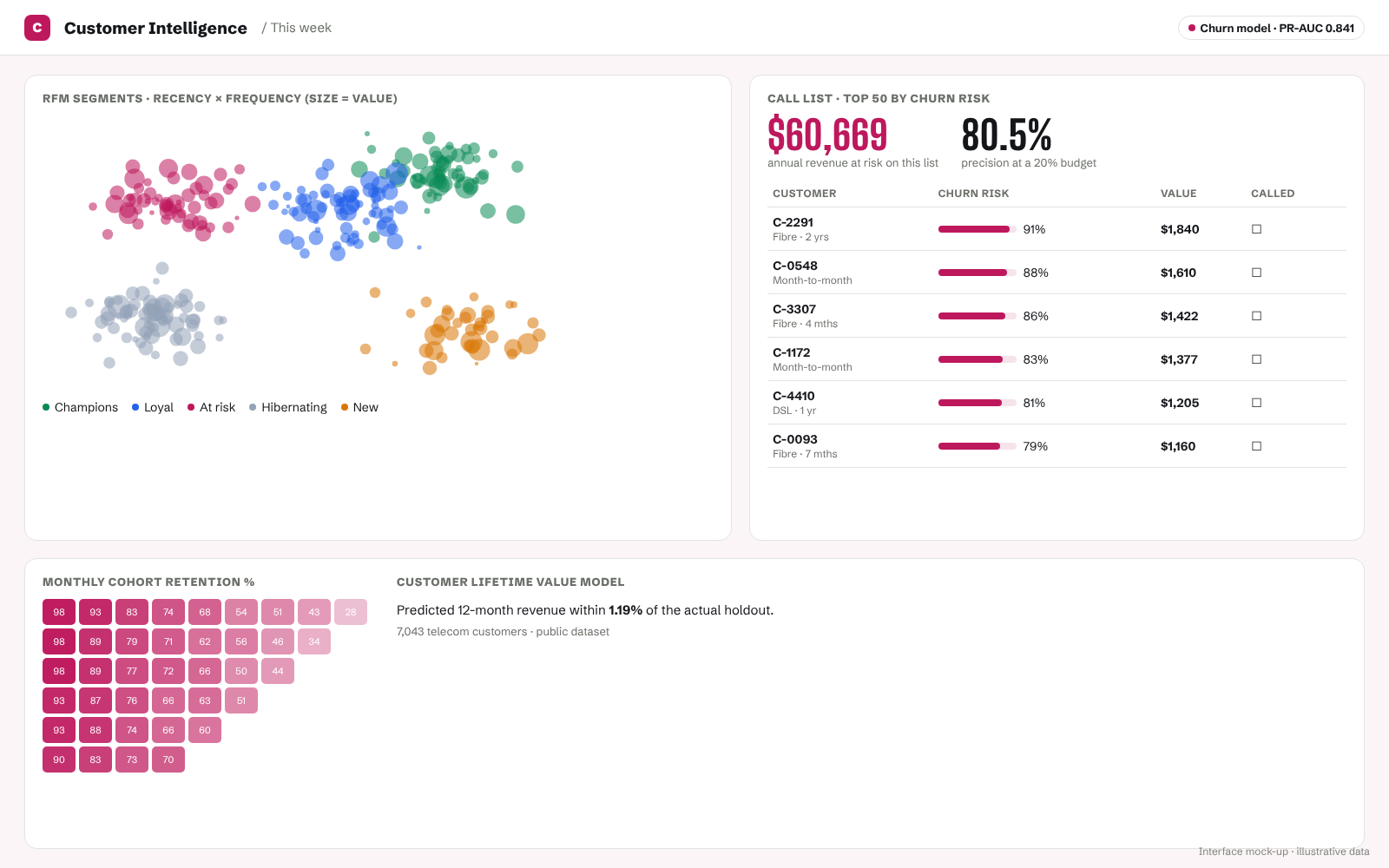
Customer Intelligence estimates which customers are likely to leave, groups customers into segments, estimates their future value and produces a ranked list of who to call first.
The problem
A business with limited staff cannot call every customer. It needs to know whom to contact and which customers are worth the effort, with probabilities it can trust.
What I built
- A calibrated gradient-boosting churn model, with a logistic baseline to compare against.
- RFM segments (recency, frequency, monetary value) such as Champions and At Risk.
- A customer lifetime value estimate that is checked against later revenue.
- A ranked action list of the customers with the most revenue at risk.
How it’s checked
For churn I report PR-AUC and precision and recall at a fixed contact budget, with confidence intervals. For lifetime value, I predict a held-out later period and compare it with what happened.
What the results do and don’t tell you
The churn model is tested on a public telecom customer dataset (7,043 customers, 26.5% churned, a 1,409-customer test set):
- PR-AUC 0.841 (95% interval 0.807 to 0.871) and ROC-AUC 0.933.
- If you contact the top 20% of customers by risk, about 81% of them really are churners and you reach about 61% of all churners.
The lifetime value check uses simulated retail transactions (1,200 customers over 540 days), where predicted holdout revenue was within 1.2% of actual. That shows the method works on data built to behave this way. It is not evidence about a real shop. Telecom churn is also easier than churn in many other businesses, so expect lower numbers elsewhere.
My role
I built all of it: the models, the segmentation, the value check, the action list and the app.
Stack
Python, scikit-learn, gradient boosting, Streamlit.
Where these facts come from
/home/user/ai-ml-data-engineering/products/customer-intelligence/README.md/home/user/ai-ml-data-engineering/machine-learning/customer-retention/reports/metrics.json