My product
Lolo's Ledger
A trading journal and risk calculator with an educational coach. It reviews your own trades and never gives buy or sell signals.
What it is
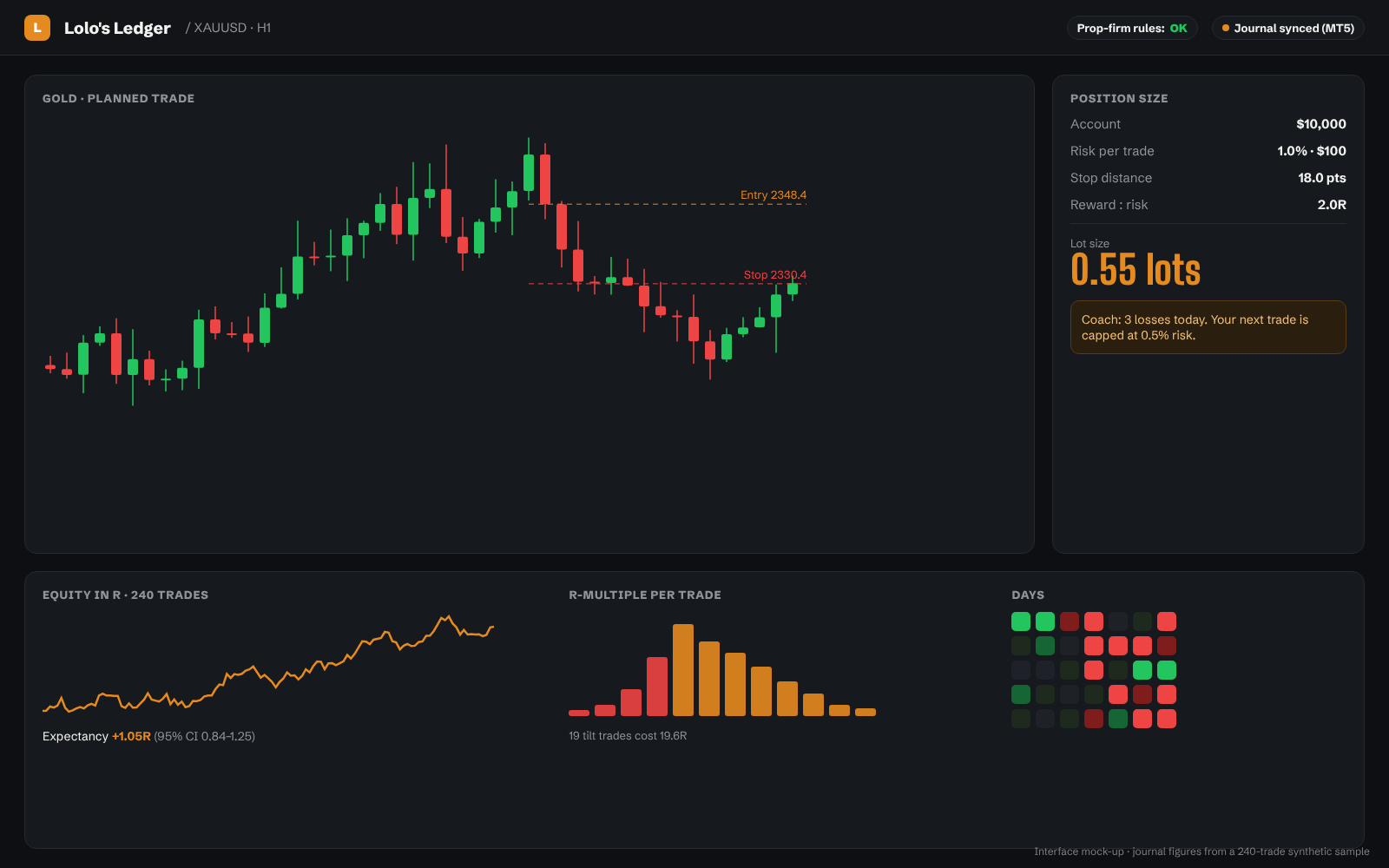
Lolo’s Ledger is a trading journal with position-size and daily-loss guards and a coach that helps you review your own process. It grew out of FXLedger, a Windows desktop journal for forex traders that I shipped as version 1.1.0. The multi-asset edition (forex, crypto, indices, commodities and shares) is still in development.
The problem
Most traders lose money through position-sizing mistakes, broken daily loss rules and not reviewing losing streaks honestly. Many journals are expensive subscriptions that keep your data in their cloud, or they push “AI signals” instead of helping you measure your own process.
What I built
- FXLedger (shipped, Windows): a local-first journal. No account, no cloud and no telemetry. It reads trades from MetaTrader 4 and 5, and calculates R-multiples, equity curves, profit factor and session views.
- Risk tools: a position-size calculator that uses each instrument’s own pip size, plus daily-loss limits and prop-firm style rules.
- Discipline tools: pre-trade checklists, post-trade reflection and detectors for revenge trading and overtrading.
- The web edition (in development): a TypeScript monorepo with an API, a background worker and a React app, and a Python module for expectancy and tilt analysis.
How it’s checked
The desktop release ships with 521 passing unit tests and a 25-test Playwright acceptance suite, with no type-check or lint errors. All profit and loss maths lives in one tested module. The web edition holds back personal-edge attribution until a trader has logged at least 100 closed trades, so it does not draw conclusions from a handful of trades.
What the results do and don’t tell you
The test counts show the desktop journal’s maths and workflows are covered by automated checks. They say nothing about whether anyone trades better with it. The coach only reviews your own logged data, and it is built to refuse requests for price predictions or buy and sell signals. It is educational and is not financial advice.
My role
I designed and built both editions on my own: the desktop app, the web monorepo and the analysis code.
Stack
TypeScript, React, Electron, NestJS, PostgreSQL, SQLite, Playwright and Python.
- FXLedger desktop on GitHub ↗ (opens in a new tab)
- Lolo's Ledger case study on GitHub ↗ (opens in a new tab)
Where these facts come from
/home/user/fx-trading-journal/README.md/home/user/AI-Trading-Intelligence/README.md/home/user/ai-ml-data-engineering/products/lolos-ledger/README.md